
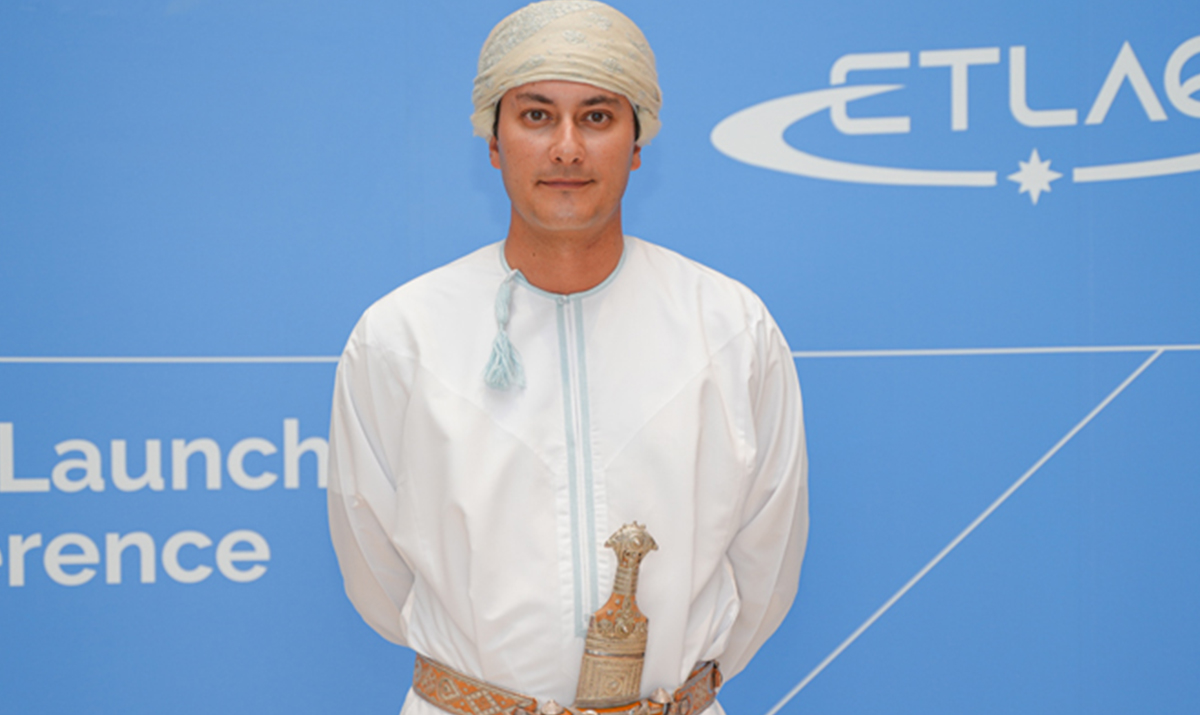
08 Feb Interview with Sayyid Azzan bin Qais Al Said, Founder and CEO, National Aerospace Services Company (NASCOM) and Etlaq Spaceport, Oman
Oman has big ambitions in the space sector, as demonstrated with the launch of its 10-year National Space Program in 2023. The national space economy was valued at $155 million in 2024 by the government and is expected to triple by 2030 — putting the sultanate on the map as a serious regional player in the commercial space. What sort of advantages and challenges does Oman have in the sector?
We have several advantages. First, our geography gives us a unique regional position for space launches due to our coastal position and access to a range of orbits. Beyond that, our strong Omani workforce — especially aviation and petroleum engineers — provides a solid foundation to develop aerospace talent and gain a competitive edge in the space sector.
Our biggest challenge is identifying our strengths and knowing where to focus. Turning simple advantages into actionable strengths is key. For example, developing infrastructure — once seen as a challenge — has become a major advantage for Oman.
The fully Omani-owned National Aerospace Services Company (NASCOM) was launched in 2021 and is focused on launch systems, satellite technologies and commercial innovation. Its flagship facility, Etlaq Spaceport in Duqm, is the first privately developed launch site in the Middle East and North Africa. Could you give our readers an overview of NASCOM?
I joined Oman’s National Space Program in its early days, starting in 2021, to identify project gaps. We realized some initiatives needed a strong private-sector role. NASCOM was then founded as a public-private partnership between the government, myself and shareholders to operationalize space projects of national importance. The spaceport project stood out, leading to the creation of Etlaq. Beyond the spaceport, NASCOM is involved in space launches — co-founding Stellar Kinetics, which executed the Duqm-1 and Duqm-2 test missions — and explores aerospace technologies like material science and specialized components for space applications.
How has the government supported the growth of NASCOM and Etlaq Spaceport?
We have a strong relationship with the government through the Ministry of Transport, Communications and Information Technology (MoTCIT), the main space regulator that oversees the National Space Program. Initially, space launches weren’t included in the ministry’s purview, but we worked together to integrate them.
The ministry’s support goes beyond funding — it is institutional backing that didn’t exist before, providing a shared vision and coordination with other ministries. For example, finding the Etlaq Spaceport site took two years and involved the Ministry of Defense, Ministry of Housing and Urban Planning and the Environment Authority, with MoTCIT acting as an umbrella and facilitator throughout.
At the start of 2024, we aimed to establish a fully orbital spaceport from scratch. The Duqm test missions bridged that gap, providing tangible results that helped shape legislation. Etlaq accelerated the process by demonstrating launches, while the regulator worked closely with the Civil Aviation Authority to create an internationally recognized spaceflight regulatory framework, supported by expert consultants in a collaborative approach.
What was behind Etlaq’s recent rebranding and how does it reflect a new strategic chapter for the spaceport?
We rebranded to blue tones, a refreshing color that marks our move out of stealth mode. Previously, everything was black to reflect secrecy. After the Duqm-1 launch, we embraced a fresh identity with the slogan “Launch, orbit, explore,” reflecting the three core offerings of a spaceport: test launches, orbital missions and deep space exploration.
Etlaq’s Genesis Program is its central strategy at the moment. Launched in 2024 and set to run to 2027, its focus is on research and development, rapid prototyping and mission testing — laying the groundwork for future orbital missions using platforms developed in Oman and the UK. What is the vision behind the Genesis Program?
My background is in software and blockchain, where the first block is called the Genesis block. Therefore, we named this early program Genesis because it builds spaceport capabilities, prepares national stakeholders and gives our team real launch experience. I see it as creating a heritage of space launches to support full operations by 2027 and beyond.
The jump from Duqm-1 to Duqm-2 was significant. Duqm-1 used a proven, small vehicle with simple ground systems. Duqm-2’s Kea-1 vehicle was brand new, requiring a complete ground system and new technologies. Each launcher has unique requirements, giving us broad experience. Our goal is to help standardize launch operations, shaping the future of spaceports and the industry.
NASCOM aims to strengthen Etlaq into a fully operational orbital spaceport with a high launch cadence, doubling each year. Beyond Etlaq, we plan to develop launch systems and additive manufacturing to support space technologies. The broader vision is a ‘Space Coast’ in Duqm with multiple spaceports and local manufacturing — like a Cape Canaveral for the Gulf region.
Talent development is core to Oman’s space ambitions. In July 2025, for example, MoTCIT launched the National Space Accelerator Program to support startups and small businesses, while NASCOM is investing in local capacity with training, graduate accelerators and R&D projects. How effective have these initiatives been so far?
At NASCOM, the majority of our workforce is Omani. Participating in the space economy does not require everyone to study space science; the industry is accessible to the broader workforce. Our upcoming training program will prepare participants to work at any spaceport globally, supporting standardization and employability. Beyond skills, we aim to inspire young people — over the past year, many have been motivated to build turbo pumps or 3D-printed rocket engine parts, building a strong national talent base for the growing space sector.
We are also collaborating with Sultan Qaboos University, Muscat University and we have initiated discussion with the German University of Technology in Oman. Local universities are showing increasing interest and are expected to become more actively involved next year through our training programs.
The future looks bright for Omani entrepreneurs and small and medium-sized enterprises in the space sector too, with many emerging niches evolving into full-service opportunities. For example, the ground system for Duqm-2 was developed by an Omani company under the guidance of international launch partners. This collaboration provided the local company with valuable equity and hands-on experience creating mutual benefits for both sides and strengthening Oman’s growing space ecosystem.
From day one, NASCOM and Etlaq Spaceport have relied on a global model — partnering with launch experts and technology providers from the UK, New Zealand, and the US. How crucial have international partnerships been to your progress?
Their support has been both critical and validating. At the 2024 Middle East Space Conference, even an American launcher engaged with us during the early stages, giving us momentum and confidence. The space industry is inherently global, and we understood from the beginning that our success would depend on international collaboration and shared expertise.
How open is NASCOM to further US participation, whether through co-development, funding or technology sharing?
The momentum in Oman’s space sector is strong right now. US investors can support our spaceport without export restrictions, which is a key opportunity. Oman also offers world-class industrial services, including high-precision machining that directly supports the development of vehicle components and related technologies. Beyond launch activities, there are promising opportunities for investors to engage in satellite services, research partnerships and supporting industries within the rapidly expanding regional space economy.
The dream is to have SpaceX in Oman one day. I am a fan of their technology and the innovative leadership of Elon Musk. We look forward to welcoming leaders of the space industry to the country. Oman is eager to join the global space economy and aims to become an extension of US space capabilities, helping US leaders access the rest of the world through Oman.