
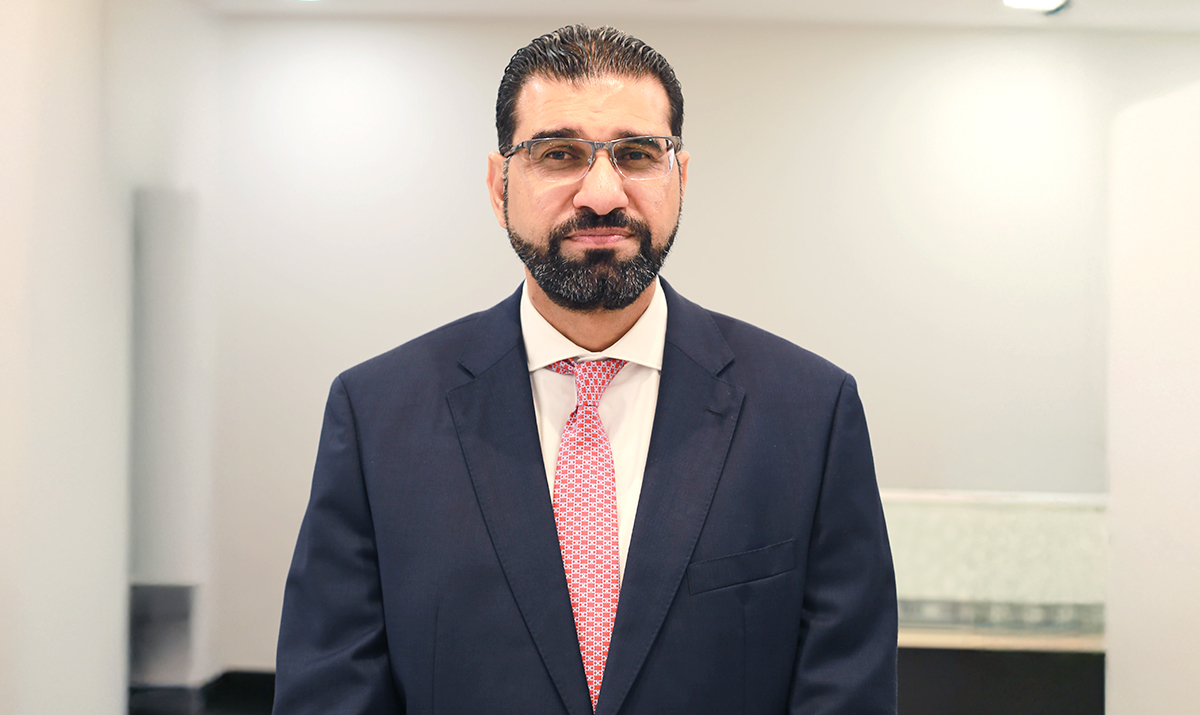
12 Feb Interview With Khalid Jamal Al Kayed, CEO of Bank Nizwa, Oman
Oman’s financial services sector continues to expand across banking, Islamic finance, insurance and capital markets — its total credit volumes surpassed $88.69 billion in August 2025, an 8.6% year-on-year rise. The industry has also experienced a series of heavy reforms, including the launch of a regulatory framework for digital banks in 2024 and the New Banking Law, which became effective in January 2025. To begin this interview, could you give us a quick overview of the sector and explain how Omani banks are contributing to economic diversification under the Oman Vision 2040 development strategy?
The banking sector is a key pillar of Oman’s economy and will continue to play a vital role in supporting both economic growth and the implementation of government vision and policies. Recent statistics show healthy performance, with stable growth in financing and deposits across various sectors. Asset quality remains strong, there is high liquidity, capital and profitability, and the Omani rial is stable, supported by effective regulation and oversight from the Central Bank of Oman (CBO). This stability allows banks to back economic growth, support investors and maintain strong correspondent relationships, particularly with US banks, linking Oman closely to global markets.
Today, banks are aligning their strategies with Oman Vision 2040, focusing on the same priority sectors. For example, Omani banks, including Bank Nizwa, are advancing digital initiatives, supported by new CBO regulations and open banking opportunities, which can expand financial inclusion and market share. The sector is also well-positioned to support trade finance, cross-border transactions and foreign direct investment (FDI), aligning with government guidance. In summary, Oman’s banking sector remains strong and continues to offer growth potential, including in Islamic banking.
In Oman, the banking sector is divided into conventional and Islamic banking. Islamic banking, introduced as part of the country’s economic diversification, has grown successfully over 12 years to capture around 20% of the market, with double-digit year-on-year growth. It supports government initiatives, corporate financing —including large and mid-sized projects and small and medium-sized enterprises (SMEs) —and retail banking. Islamic banks also play a key role in investment and capital markets, supporting government instruments like sukuks. Bank Nizwa is a fully-fledged Islamic bank and the first of its kind in Oman. Since starting with $400 million, we have grown to $5.1 billion and are now aiming to expand regionally.
What long-term strategy defines Bank Nizwa’s current growth trajectory, and what key targets has it set moving forward?
Established in 2013, Bank Nizwa reflects the full journey of the Islamic finance industry in the country. We grew from a startup into a strong, full-service bank offering retail, corporate, treasury and investment services — all Sharia-compliant. Our strategy focuses on expanding within Oman and regionally, especially in trade finance, syndications and supporting FDI.
We are also advancing two key pillars: digitalization and sustainability. Our goals are to build the next-generation Islamic digital bank for Oman and the region, while sustainability is fully embedded in our corporate strategy. As an Islamic bank, we see strong alignment between Sharia principles and the UN Sustainable Development Goals. With board-level approval, we have mapped our products to these objectives. Bank Nizwa was the first in Oman to issue environmentally friendly credit cards and offers green financing, including special products for renewable energy projects, for example. This approach bridges Islamic values with global sustainability goals.
Our social focus centers on women, education and health. In governance, Islamic banking naturally offers higher transparency and stricter oversight than conventional banking, with both financial and Sharia audits ensuring ethical practices. For example, during COVID-19, our clients benefited from profit-free payment deferrals, demonstrating our fairness and compliance. We have completed the first phase of our sustainability strategy and are now deepening it.
Bank Nizwa leads Oman’s Islamic banking sector and will continue expanding into focused segments such as wealth management, women, young people, education and healthcare — aligned with Oman Vision 2040. On the corporate side, we support diversification sectors like fisheries, logistics and manufacturing.
Bank Nizwa champions innovation through workforce development and “Omanization.” In August 2025, it launched the second edition of its NANMU upskilling program and participated as a Gold Partner in the Oman Career Fair 2025. How is Bank Nizwa working with educational institutions and government entities to promote financial and banking education in Oman and create sustainable career opportunities for Omanis?
When we launched Bank Nizwa in 2013, we recognized we weren’t just building a new bank — we were helping establish an entirely new industry. From the start, we focused on raising awareness and educating the public about Islamic banking, visiting universities, schools and cities across Oman. We also built strong partnerships with international institutions such as the Accounting and Auditing Organization for Islamic Financial Institutions, the Islamic Financial Services Board and the Islamic Development Bank to align with global standards and build local capacity.
At Bank Nizwa, learning and development are strategic priorities. We invest in leadership programs for senior and mid-level Omani managers, as well as specialized training in digital banking and sustainability. This includes executive education from institutions like Harvard, Columbia and Cambridge. Our approach ensures continuous learning, alignment with global best practices and sustainable industry growth. We also partner with Omani universities and government entities to build local expertise and strengthen the Islamic finance ecosystem. We take pride in developing Omani talent for the entire industry — even if they move on—because this contributes to the growth of Islamic banking in Oman.
At many conferences, I highlight that Oman ranks 15th globally in Islamic banking — an achievement that reflects not just market share, but also governance, knowledge and awareness. For instance, these rankings consider how many universities offer Islamic finance courses and how active a country is in hosting conferences and promoting education.
FDI in Oman is rising sharply, growing from $1.9 million in 2020 to $8.68 million in 2024, according to the United Nations World Investment Report. How vital are international partnerships to Bank Nizwa’s growth strategy?
Regional expansion is a key part of Bank Nizwa’s next growth phase. We already have international investors in our portfolio but aim to strengthen this presence. Beyond our regional expansion, we are receiving strong interest from other countries — particularly in Europe and Central Asia — seeking to develop Islamic banking. Some have engaged directly with us to learn from Oman’s experience. We are also in discussions with partners in Central Asia and Africa to provide advisory support and correspondent banking services for trade finance. Oman’s strategic location gives us excellent reach and, through these partnerships, Bank Nizwa aims to share its expertise while creating new value for Oman.
At Bank Nizwa, our board-approved strategy is built on connection and collaboration. In Oman, we apply this by strengthening the Islamic finance ecosystem and linking our strategy with other stakeholders to ensure sustainability. It’s not about competition — it’s about inclusion. A good example is our open banking partnerships with fintechs, where we have created win-win relationships that improve customer service and expand reach. We believe this collaborative approach can also guide our international growth through partnerships and shared expertise.
Globally, Islamic finance reached about $5 trillion by the end of 2024 and is expected to grow to $7.5 trillion by 2027 — a scale no one can ignore. Around 60% of these assets are in banking and 20% in sukuk. While activity is spread across many countries, major contributions come from Saudi Arabia, the United Arab Emirates, Malaysia and Indonesia, which are driving growth and international participation in the Islamic finance market. In the Gulf Cooperation Council (GCC) region, governments are increasingly issuing sovereign sukuk instead of conventional bonds. As a result, the sukuk market is expected to reach $1 trillion, attracting both traditional and Sharia-compliant investors — making it a larger and safer market overall.
There is untapped potential for US participation in Islamic banking. Most sukuk are issued in dollars but listed in Europe. If the US market introduced more Sharia-compliant indices or listings, it could attract significant investment from the GCC and Asia. At Bank Nizwa, we already invest in US markets through Sharia-compliant indices, which shows this model can work successfully.
Since assuming the role of CEO in 2017, you have overseen robust growth in assets, customer base and profitability, while positioning Bank Nizwa as Oman’s top-performing Islamic retail bank. How do you envision Bank Nizwa’s future role in shaping Oman’s Islamic banking landscape?
Bank Nizwa is moving strongly toward digitalization while maintaining a focus on ethical banking and sustainability. We aim to spin off a fully digital bank while continuing to serve corporate and retail clients with personalized, segment-focused products. Our strategy also emphasizes open banking, which allows us to expand beyond borders through partnerships and innovative use of client data. The combination of digitalization, open banking and ESG-focused products will deepen client relationships and enhance the bank’s contribution to the economy.
What message would you like to send to the readers of USA Today?
There is a golden opportunity to create value by exploring opportunities in Oman and the US. Oman offers a safe, stable and investment-friendly environment with untapped potential, while the US provides significant resources and partnerships. This dual focus can generate substantial benefits for both countries, making Oman an ideal gateway for growth and investment in the region.