
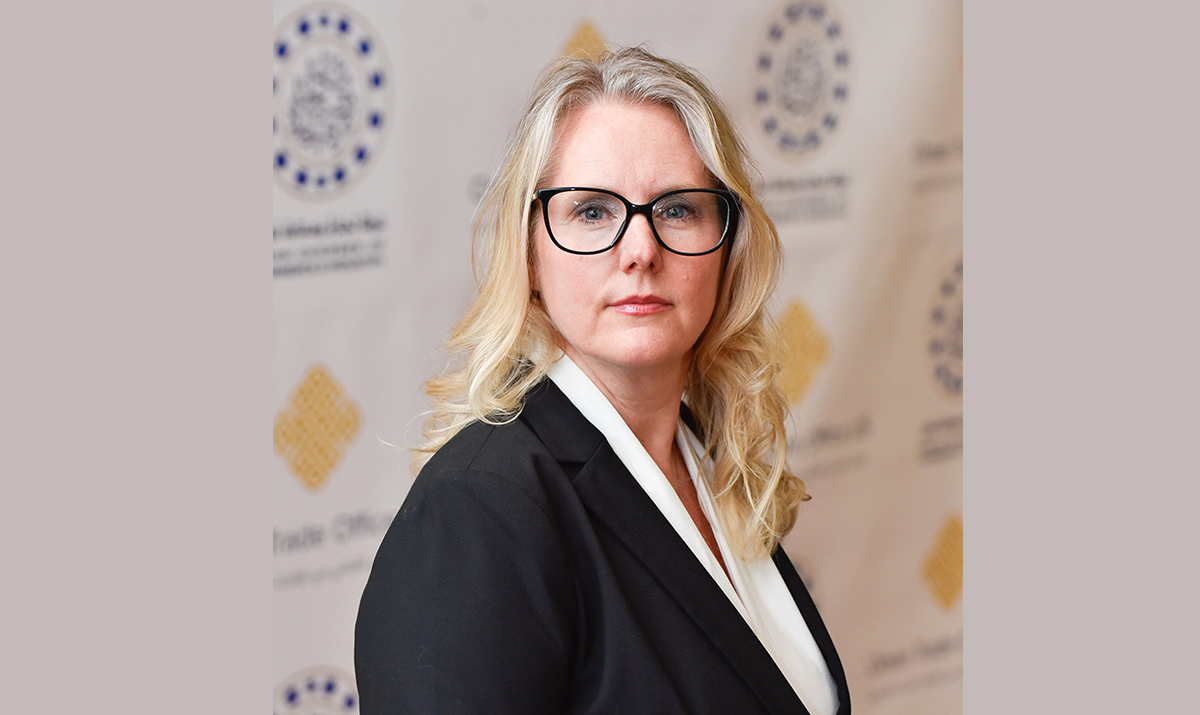
08 Feb Interview with Emmee Haun, Managing Director of Oman Trade Office US
Launched in 2025, the Oman Trade Office US serves as a direct economic bridge for expanding commercial cooperation and bilateral investments between the two countries. Can you explain its mission and share the journey that led to you heading the office?
We are a bilateral trade office, supporting both Oman and the US. For Oman, we help companies enter, navigate and grow in the US market while positioning Oman as an attractive trade and investment partner. For US companies, we promote Oman as a reliable sourcing alternative across sectors like plastics, perfumes and raw materials. Our work is organized around three core programs, all free for participating companies and funded by the Oman Chamber of Commerce and Industry. The Market Entry and Expansion Services program, for example, supports trade in both directions. We are also launching an industry-focused Export Accelerator, modeled on tech accelerators, to build awareness of Omani brands in the US.
I have lived and worked in Oman for almost 22 years. I originally came as a US government employee working on Middle East free trade agreements, covering Morocco, Bahrain and eventually Oman. I realized I loved it there and decided to stay. My children were born in Oman, and it became my home. I left the US government to focus on trade, investment and oil and gas in Oman, and my specialty is FTAs and bilateral trade, particularly between Oman and the US.
I won the contract to establish the Oman Trade Office US, which officially launched in May. We brought a 25-member delegation for SelectUS and opened in Washington DC at the Sultan Qaboos Cultural Center. Our office is Oman’s on-the-ground presence in the US. I personally selected our team for their complementary skills: I cover Oman, the Gulf Cooperation Council (GCC) region and India; one team member supports US entities exploring Oman and another focuses on bilateral investment attraction. It is a busy time to be here, navigating bilateral trade and investment, and we are committed to building strong, lasting partnerships.
What key factors have fueled Oman’s economic growth momentum in recent years?
The Oman Vision 2040 development strategy has provided a clear roadmap for sustainable, diversified growth. Having been part of the Vision 2040 team, it has been incredible to see this new vision being implemented. The strategy builds on Oman’s strengths — energy, logistics and natural resources — while accelerating diversification into downstream industries, advanced manufacturing and renewable energy, including hydrogen, wind and solar.
Over the past six to eight years, we have seen tremendous growth in Omani products reaching the US and other global markets. Tourism has also grown impressively, leveraging Oman’s natural appeal. Alongside the vision, investment reforms, updated laws and incentives have created the foundation for gross domestic product growth and long-term economic development.
Having worked in Oman for many years, specializing in foreign direct investment attraction, it is amazing to see how the business environment has evolved. Oman now offers one of the region’s most open FDI frameworks, especially in free zones, with 100% foreign ownership, tax and customs incentives and strong infrastructure. Over the years, I have seen companies from all over the world invest here. Historically, many came from Southeast Asia, but now US investment is growing in emerging sectors like renewables and electric vehicle (EV) battery supply chains. The shift shows that Oman’s openness and incentives are effectively attracting global investors.
In force since 2009, the US-Oman Free Trade Agreement anchors a robust bilateral trade relationship. In 2024, total goods and services trade between both nations reached roughly $4.3 billion. How does the FTA strengthen Oman’s position as a regional gateway for American business and trade?
The US-Oman trade relationship dates back to 1833 with the Treaty of Amity and Commerce, long before the 15-year FTA we celebrated last year. This longstanding partnership has fostered trust and steady trade growth over decades. Since the FTA was introduced, Omani exports to the US have diversified, with remarkable growth in sectors like perfumes and essential oils (over 6,000% growth in 15 years), plastics (435%), iron and steel products and vehicle parts. US exports to Oman have also grown consistently, reflecting Oman’s demand for US technology, expertise and products. The trade balance generally favors the US, with steady annual growth of 3-5%.
Under the FTA’s rules of origin. Products must have at least 35% value added in Oman to qualify. As Oman attracts more investment, more goods are produced locally for export. The Oman Trade Office US advises companies on meeting these rules to access FTA benefits.
The FTA remains solid and ongoing, offering certainty and confidence for businesses on both sides. As one of only two US-FTA countries in the GCC, Oman provides US firms with regional access. For Omanis, the US is a key partner for technology, expertise and investment.
The sultanate is uniquely positioned for US investors. Oman is entering a new era of innovation and partnership — agile, open and business-friendly. Its FTA provides stable, duty-free access that is unaffected by changing trade policies. Oman’s strategic location in the region is a major advantage for American companies, its political and economic stability makes it a reliable partner, its incentives are competitive and its infrastructure is modern.
Where are the best opportunities for US investors in Oman, in your opinion?
There are broad opportunities for US companies in renewables — from hydrogen, wind and solar to technology, equipment and consulting — and in the EV battery supply chain, which is attracting strong interest. Mining and minerals is another key sector, where US expertise in technology, equipment and engineering is in high demand. Technology in general also presents opportunities beyond free zones.
What measurable impact has the office had on trade and investment ties between Oman and the US since its launch?
We have already seen several success stories. For example, we brought Oman’s largest-ever delegation to SelectUSA and facilitated key introductions. Omani companies exporting to the US have connected with buyers, primarily in the industrial sector. Two US companies seeking alternative sourcing have already begun shipments from Oman. We are also supporting joint ventures — one US company exploring a facility in Oman and an Omani company entering the US market.
How does the office help Omani businesses scale up their presence and competitiveness in the North American market?
We focus on helping Omani manufacturers export to the US through a tailored export readiness program. Companies join at different stages — some are new to exporting, others are emerging exporters. We assess their needs, provide FTA guidance, market research, trade show preparation and make introductions to potential buyers. While we also run industry-based cohorts, the program is customized for each company’s export journey, ensuring they are fully prepared to enter the US market.
Oman is accelerating innovation by nurturing entrepreneurship and upskilling local talent. To illustrate the extent of those efforts, the sultanate has advanced to eighth place in the latest Global Entrepreneurship Monitor. Can you give some examples of how the country is assisting small and medium-sized enterprises and skills development?
SMEs in Oman have grown significantly over the past decade, supported by programs like the SME Development Authority and various in-country value initiatives. Funding programs, such as the Oman Future Fund, along with bank and Oman Investment Authority partnerships, also provide vital resources, helping SMEs expand and attract foreign investment. At the Oman Trade Office, we work with nearly 60 companies, around 40% of which are SMEs.
In terms of skills, Oman’s Ministry of Transport, Communications and Information Technology offers a great example of coordinated investment and workforce development. They have attracted investment in sectors like semiconductors while building programs to ensure a skilled labor force. Across new industries, the Ministry of Labor and technology colleges are aligning skills with private sector needs — a model other countries could follow.
What inspired you to take on the role of managing director at the Oman Trade Office US and what vision guides your efforts to strengthen economic ties between both nations?
What inspired me was the encouragement from Oman and my deep connection to the country. I have long worked on attracting foreign investment to Oman but helping Omani products reach the US under the FTA on a large scale was missing. Now, companies come to me with products I didn’t even know existed and we see the US market potential immediately. I built a team with US experience to act quickly, focusing initially on Texas, Illinois and Pennsylvania — our top three states for synergies. Helping Omani exporters apply the FTA knowledge and access the US market has been incredibly rewarding.
We aim to grow trade, attract foreign investment and create jobs in Oman, all aligned with Vision 2040’s diversification and employment goals. Being on the ground allows us to build partnerships with local stakeholders and industry associations. We are proud to be the Gulf’s first privately funded trade office, putting Oman on the map and supporting both sides.